INSTITUTIONAL PHILOSOPHY
Mar Dioscorus College of Pharmacy believes that pharmaceutical education should be grounded in ethical values, social responsibility, and professional excellence. The institution is committed to nurturing competent pharmacy professionals by fostering moral integrity, dedication to learning, compassionate patient care, and professional wisdom. Through quality education, research, and service, the college strives to contribute meaningfully to healthcare and societal well-being. Guiding Motto: “Fear of God is the beginning of wisdom”
MDCP CORE VALUES
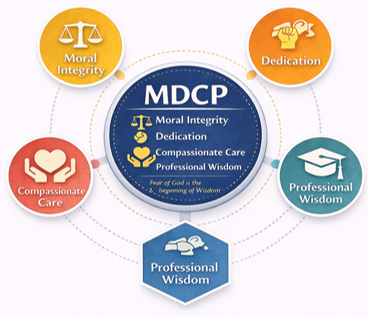
The core values of Mar Dioscorus College of Pharmacy are:
- - Moral Integrity – Upholding honesty, ethics, and accountability in all academic and professional practices
- - Dedication – Commitment to excellence in education, research, and service
- - Compassionate Care – Promoting empathy and patient-centered healthcare
- - Professional Wisdom – Encouraging critical thinking, lifelong learning, and responsible decision-making in pharmacy practice
CURRICULUM FRAMEWORK
The curriculum is structured around the KUSA framework—Knowledge, Understanding, Skills, and Attitude—to ensure holistic development of students in alignment with the guiding value of Moral Integrity, Dedication, Compassionate Care, and Professional Wisdom.
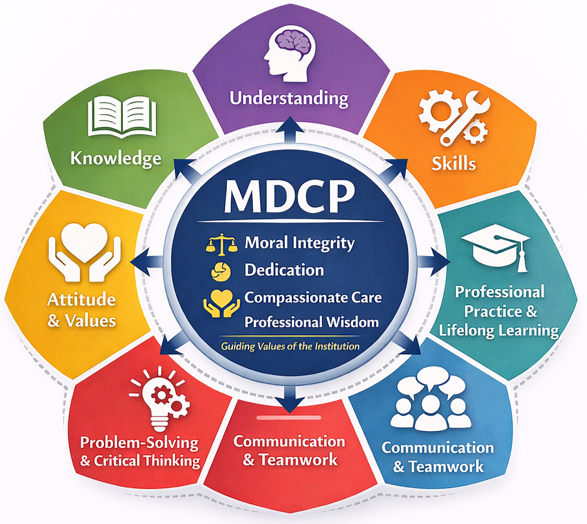
Knowledge and Understanding:
- - Adequate knowledge and scientific information regarding basic principles of
Pharmaceutical Chemistry, Pharmaceutics including Cosmetics, Pharmacology
and Pharmacognosy including Herbal drugs.
- - Adequate knowledge of practical aspects of synthesis, formulation and analysis
of various pharmaceutical and herbal medicinal agents.
- - Adequate knowledge of practical aspects of delivering a quality assured product
- - per Pharmacopoeia, WHO and ISO standards.
- - Adequate knowledge of practical aspects of Pharmacological screening,
biological standardization and in-vivo drug interactions.
- - Adequate knowledge of clinical studies for patient counseling leading to physical
and social well being of patients.
- - Adequate knowledge of practical aspects of product detailing and marketing of
pharmaceutical products.
Skills:
- - - Able to synthesize, purify, identify and analyze medicinal agents.
- - - Able to formulate, store, dispense, analyze the prescriptions and / or manufacture
the medicinal agents at commercial level.
- - - Able to learn and apply the quality assurance principles including legal and
ethical aspects involving drugs.
- - - Able to extract, purify, identify and know the therapeutic value of herbal / crude
/ natural products.
- - - Able to screen various medicinal agents using animal models for pharmacological
activity.
Attitude & Values
- - Willing to apply the current knowledge of pharmacy in best interest of patients
and the community.
- - Maintain a high standard of professional ethics in discharging professional
obligations.
- Professional Practice & Lifelong Learning
- - Continuously upgrade professional information and be conversant with latest
advances in Pharmacy field to serve the community better.
- - Willing to participate in continuing education programmes of PCI and AICTE to upgrade knowledge and professional skills.
- - To help and to participate in the implementation of National Health Programmes.
Communication & Teamwork
- - Patient counselling
- - Interprofessional collaboration
- - Documentation and reporting
Problem-Solving & Critical Thinking
- - Therapeutic decision-making
- - Research aptitude
- - Evidence-based practice
Outcome-Based Education (OBE)
Outcome-Based Education (OBE) is an educational model that forms the base of a quality education system. There is no single specified style of teaching or assessment in OBE. All educational activities carried out in OBE should help the students to achieve the set goals. The faculty may adapt the role of instructor, trainer, facilitator, and/or mentor, based on the outcomes targeted.
OBE enhances the traditional methods and focuses on what the Institute provides to students. It shows the success by making or demonstrating outcomes using statements "able to do" in favour of students. OBE provides clear standards for observable and measurable outcomes.
Focus on OBE
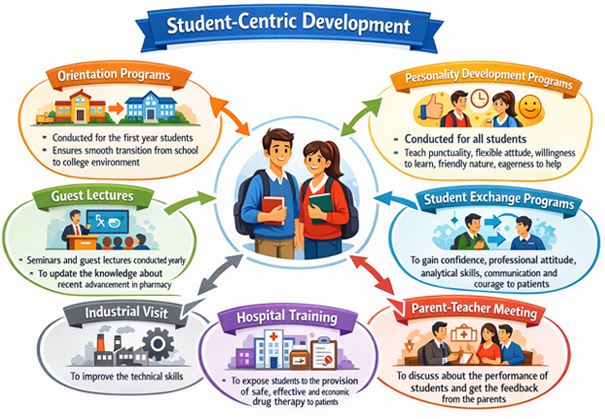
MDCP has mentoring and feedback systems in place for early identification of learning abilities of the students that ultimately help bridge the learning gap and promote continuous improvement in students through dedicated efforts by the faculty. Effective curriculum delivery methods, use of modern ICT tools, efficient use of teaching pedagogy, and execution of add-on/value-added courses are some major initiatives taken for OBE, resulting in remarkable CO-PO attainment and students’ academic improvement. The curriculum enrichment is achieved through experiential learning where maximum students participate in project work, field work, Industrial visits, participation in college, inter-college, state, and national level competitions (NPW, Ideathon, Hackathon), etc. The other activities, like guest lectures, training sessions, seminars, and workshops, are regularly organized to inculcate a research attitude and keep them well-informed with the latest industrial developments. Students undergo one month of ‘Industrial training’ to understand the corporate environment. The college encourages add-on courses on advanced technologies and applications. Various software and E-learning resources promote self-directed problem-solving learning in students. Thus, comprehensive Learning outcome-based curriculum framework (LOCF) helps students to make choices regarding courses they wish to study as per the NEP-2020 mandate.
1.1 Curricular Planning and Implementation
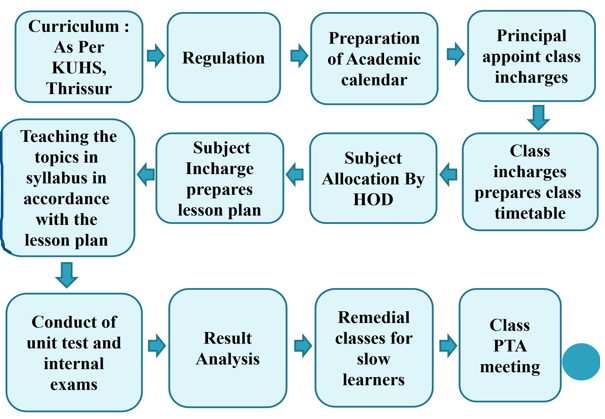
Being affiliated college to Kerala University of Health Sciences, the college follows the curriculum and syllabus prescribed by the University and Pharmacy Council of India. The Curriculum Planning and Delivery at the college adopts the following.
The curriculum is designed to familiarize pharmacists with the abilities and skills required in pharmaceutical care and to improve the professional potency of each and every candidate through the expertise training.
- - Each and every subject is supported with the practicals to improve their skills for fulfilling the competency in the healthcare profession.
- - Cultivating a research-based approach is an essential part of the curriculum. The institution is providing a strong backup for the research aspirants.
- - The organizing ability of the students is promoted through their active participation in various committees.
Academic Planning
Academic calendar
The academic calendar is prepared by the Academic Monitoring Committee (AMC) on the basis of commencement terms and working days provided by the University and the Admission Regulatory Authority. IQAC. AMC, Programme Monitoring Committee and examination committee also plays an important role in the Continuous Internal Evaluation (CIE). Academic calendar consists of proposed dates of the following activities
- Academic activities:
- - Commencement of academic term
- - Nos. of Working Days
- - Add on/Value added courses.
- - Vacations
- - Parent-teachers meet
- - Term end Dates
- - All the academic activities & internal assessment exams are executed as per the academic calendar plan.
- - Workload distribution is done by the collective wisdom of all HoDs, and the academic committee prepares a timetable which is approved by the principal.
- - Faculty members prepare lecture plan and course material well in advance which is approved by the HODs.
Academic calendar is disseminated among stakeholders through college website and notice board. All activities listed in the academic calendar are monitored by the AMC. The faculty meetings are conducted on regular intervals to review adherence to activities mentioned in academic calendar.
- 1.2 Academic Flexibility
- - The Institute is affiliated with KUHS, Kerala.
- - B Pharm & M Pharm courses offered in a semester pattern
- - Pharm D & D Pharm courses are yearly pattern
- - B.Pharm students can opt for core subjects as per the curriculum.
Academic Implementation
- - Teaching, learning, and progress monitoring are conducted in a blended mode using ICT-based teaching aids. Academic progress is regularly appraised by the Academic Monitoring Committee.
- - Feedbacks are conducted to evaluate the teaching learning process.
- - Learning Outcomes are mapped with Course Outcomes for understanding the outcome attainment levels.
Bridging the Gap
- - Content beyond the syllabus is identified to bridge the gap between and within subjects.
- - For slow and advanced learners, tutorials, add-on/value added courses are planned and executed.
Faculty Development
- - Industry visits, regular FDPs, faculty participation in research competitions and conferences, and annual NPTEL certificate course help faculty to match the current knowledge.
1.3 Curriculum Enrichment
Curriculum enrichment in the college is designed to holistically inculcate professional ethics, gender equality, human values, and sustainable development among students for the greater benefit of society. These values are integrated not only through academic content but also through co-curricular and extra-curricular activities. These values are highlighted through curriculum and other activities as given below.
1) Professional Ethics: - Communication Skills and Soft Skill Development (F. Y. B. Pharm) develop the skills such as writing, speaking along with soft skills.
- Environmental Sciences (F. Y. B. Pharm) covers environmental issues and Pharmaceutical Jurisprudence (Third Year B. Pharm) educates laws obeyed.
- Drug Regulatory Affairs and Research Methodology study offers regulatory aspects in pharmaceutical industry and research required for societal benefit.
- WHO days are observed for disease awareness and measures taken. The Code of Conduct is followed by faculty, staff and students.
The professional ethics are inculcated through Training, Research, Curricular, Extracurricular and Extension activities.
2) Gender Equality: - Equal opportunity for students in Sports, Cultural, NSS activities and etc. their representation in respective committees of college.
3) Human Values: - Human values are inculcated in students through various subjects in both courses.
4) Environment and Sustainability: - The campus is a lush green area within the city limits, adorned with a rich variety of trees, flowering plants, and regional fruit-bearing trees, creating a refreshing, oxygen-rich environment. E-waste is collected and supplied to the vendor. Medicinal Garden and Biogas plant are well maintained.
5) Social Activities: - The college takes efforts for the integration of ethics, human values, and the Environment into the curriculum. N.S.S. organizes various environment related programs including tree plantation, plastic-free drive, etc. Different social activities like Voter’s Awareness Program, Blood Donation camps, etc are organized from time to time.
6) PMKVY 4.0: - The college has taken an active organization of the Pradhan Mantri Kaushal Vikas Yojana (PMKVY) 4.0 Recognized Prior Learning (RPL) Scheme in retail pharmacy organized by the Life Sciences Sector Skill Development Council (LSSSDC) under PMKVY 4.0 initiative.
7) Celebration of National Festivals: - National festivals like Independence Day and Republic Day celebration serve as a platform to enliven patriotic and moral values.


